

If you’ve ever tried opening oysters at home, you already know how quickly it can go sideways. That’s why we put together this 2026 guide to present the best oyster shucker for home use.
What starts as a good idea — fresh oysters, a couple drinks, maybe friends coming over — turns into a slow, awkward process at the counter. You’re adjusting your grip, second-guessing the angle, wondering why some open easily and others feel impossible. Usually some guy wants to prove how good he is at shucking oysters… and that can become a liability. At some point, we wonder, “Is there actually a better way to do this at home?”
There is. But not all tools solve the problem the same way.
What Actually Matters in an Oyster Shucker
Most people assume this comes down to strength or technique. It doesn’t. Opening oysters gets easier when a few key things are working in your favor:
- Stability — the oyster stays in place while you work
- Controlled pressure — not force, but direction
- Consistency — the motion doesn’t change every time
- Safety — your hands aren’t in a vulnerable position
When those are in place, the whole process settles down. You’re not reacting to each oyster — you’re working through them.
Most Oyster and Clam Shucking Tools are More Dangerous at Home
The traditional oyster knife has been around forever, and it works. But it also assumes a level of experience that most home cooks don’t have.
Imagine you’re holding an uneven shell in one hand, applying pressure with the other, trying to find the hinge and twist at the right moment. If everything lines up, it feels smooth. If it doesn’t, you hesitate — or push harder. That’s where things can get squirrelly.
Cheaper “home shucking tools” don’t necessarily fix this either. Many still rely on grip strength or awkward positioning, which means you’re still adjusting from oyster to oyster. And in a real home setting — not a professional kitchen — you’re usually not fully focused on just the task. There’s conversation, movement, maybe a drink in hand. That’s where inconsistency shows up fast.
What Makes an Oyster Shucker Worth the Investment
Objectively speaking, shucking oysters at home means there are many factors to consider – and the most important ones are distractions and inexperienced guests. A good oyster shucker shouldn’t rely on perfect technique. It should remove variables.
The oyster is secured. The pressure is applied in a controlled direction. The motion becomes repeatable. The opened oyster or clam is a predictable outcome – not a victory.
Instead of, “Hold on… this is a tough one!” It becomes, “Give me a second.” Calm. Predictable. Clean. You know you just need to reposition the oyster and you’re good to go. And when you’re opening more than a handful — or hosting — that difference matters more than most people expect.
Best Oyster Shucker for Home Use
If your goal is to make oyster prep easier, safer and more consistent at home, the tools that stand out all have one thing in common: They control the environment instead of relying on the user to compensate for it.
 Mechanical Oyster Shuckers Remove Dangerous Variables
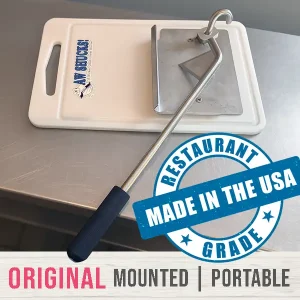
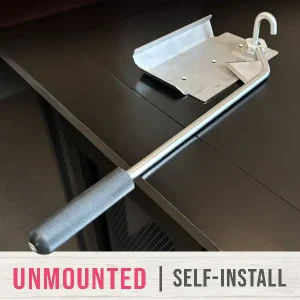
Rather than forcing a blade into the hinge while stabilizing the oyster with your hand, a mechanical setup holds the shell in place and applies pressure in a controlled way. The motion doesn’t change. The variables are reduced. For home use, that translates to:
- less strain on your hands
- fewer awkward adjustments
- little to know unexpected slippage
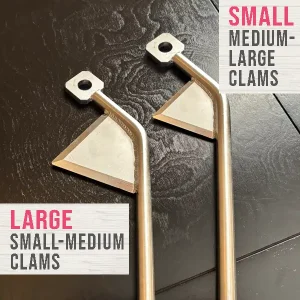
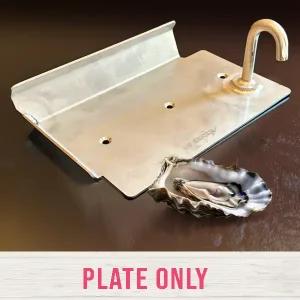
Tools like the Aw Shucks Oyster Shucker were designed with that exact goal in mind — not replacing tradition, but making the process more controlled and repeatable for mass quantities in a restaurant, and safer in a home setting.
If you enjoy oysters regularly that consistency starts to matter more than the tool itself.
Final Thought
There isn’t anything wrong with using a knife. For some people, that’s part of the experience. But if you’ve ever found yourself slowing down, hesitating, or wondering why the process feels more unsafe than it should, it’s worth stepping back and looking at what’s actually causing that friction.
When you remove the variables — stabilize the oyster, control the pressure, repeat the motion — everything changes.
And when it feels safe and easy, everyone can relax and enjoy themselves more.
Related articles
- Oyster Shucker vs Oyster Knife: Which Is Safer and Faster?
- What to Get the Man Who Has Everything
- Why Oysters Are So Hard to Open — and How to Make It Easy at Home
- How Restaurants Shuck Oysters Safely — And What Home Cooks Can Learn
- Hosting an Oyster Night at Home: A Simple Guide